
Guide to Travel24’s Itinerary
Our itinerary is generally longer and has more activities listed on each day. We have initially done so to cater to our Travelers who are fast walkers/climbers or generally can complete each of them quickly. If you would like to linger or have a slower pace, please do so. You should discuss your itinerary with your guide and prioritize the attractions which you prefer the most. The wider options is also meant to provide you withpotential options if you a change of mind during your trip. If you have enough of fortresses and Dzongs, you may want to go for a trek. If you are feeling unwell, you may want to go for slower pace such as visiting the museum.
We suggest that you use your itinerary as a guide rather than a fixed schedule. Unexpected stuffs always happen in Bhutan. As Bhutan has just opened up to the world, do not expect their service to be in the same standard as visiting a Museum in London. However, they are one of the friendliest and jolly people you would ever meet.
Yours is an exclusive holiday, not to be combined with other groups at any point of stay. This explains the freedom to be flexible on this trip of a lifetime – time and weather permitting, and to the final professional discretion of your guide.
Guides
Traditional Clothes
We advise to avoid wearing traditional gear to official places & dzongs – as entry requires additional scarves, and knee-high socks for men. Still, these are available for purchase locally.
Hotels, Itinerary, Tips
Do share your preferred hotel(s) during discussions with our agents prior to payment. If not indicated, selections are made based on the best options as shared by our guests’ reviews. Certain hotels may charge additional fees on top of the standard normal rate. Accommodations are typically confirmed within 2 weeks of down payment (please allow buffer for peak seasons).
Requests
Indicate meal restrictions, allergies, special specifications for guides etc (if any).
Travel Package Details
Upon arrival at Paro International Airport, you’ll find our guide and driver holding signboard with yourname(s) on it and a big smile on their faces, all the way till your last day at the departure hall. Lookout for your Visa approval email five days prior to departure, which includes: Visa, flight E-ticket, finalized hotel list and trip itinerary.
Your Bhutanese Journey
| INCLUDES | EXCLUDES: |
| 1) A qualified & licensed English speaking guide | 1) Flight |
| 2) Visas for Bhutan | |
| 2) Monument fee | 3) Hotel Stay outside Bhutan (e.g. to catch a flightto Bhutan) |
| 3) An experienced driver | 4) Travel Insurance |
| 4) A tour vehicle | 5) Lunch & Dinner outside selected restaurants(e.g. 5-star resorts) |
| 5) All meals on tour | 6) Tips for guide and driver |
| 6) Accommodation at 3 star hotels (subject toavailability) | 7) Alcoholic drinks |
| 7) Taxes, surcharges, government contribution | 8) Expenditure of personal nature (e.g. shopping, laundry, spa and hot stone bath) |
| 8) Mineral water(500 ml) for the duration of thestay |
For Your Peace of Mind
We handle the entire booking process for our guests, including Drukair and Bhutan Airlines flights and visaapplications (included in the package) – but it is advisable to book well in advance to secure preferred accommodation and flight tickets few months ahead and plan your trip to Bhutan.
Facts & Figures
| Population | 800,000 |
| Time Zone | GMT +6 |
| Currency | Ngultrum (Nu) |
| Country Dial Code | +975 |
| Languages | Dzongkha, English |
| International Airports | Paro Airport (PBH) 1 hour by car to capital, Thimphu |
| Domestic Airports | Bumthang (BUT), Gelephu (GLU), Yongphulla (YON) |
| National Airline | Drukair and Bhutan Airlines Flies from Bagdogra, Bangkok,Delhi, Dhaka, Guwahati, Kolkata, Kathmandu, and Singapore. |
| Visa | Yes, except Indian, Bangladeshi and Maldivian |
| Nationalities Visitors | 71,417 in 2017 |
| National Animal | Takin |
| National Sport | Archery |
| National Flower | Blue Poppy |
.
7 Days 6 Nights Magical Bhutan cultural Tour
Day 1: Paro – Thimphu
Elevation 2,320m | Drive time 5 hours
Welcome to Bhutan, the Land of the Thunder Dragon. After clearing customs and immigration, you will be greeted by your Bhutanese hosts. Today, we will take it easy to acclimatize to the altitude Drive to Thimphu,check in to the hotel and let’s have your first taste of Bhutanese cuisine.
General post office – One of the most interesting things that you can do in Bhutan is to get your own personalized stamps at the General Post Office for 500 Ngultrum. It contains 12 stamps with a mix values of 30 Ngultrum, 45 Ngultrum and 50 Ngultrum. Imagine the pleasant surprise of your family and friends when you send them a postcard with your face on the stamp!
Simply Bhutan – It is a “live” Museum where the tourists can see the life of a traditional Bhutanese lifestyle. The most stunning is to see a mud-rammed house of the medieval period of Bhutan. The interior of Simply Bhutan is filled with preserved ancient household items. The living museum’s main objective is to promote ancient tradition and culture.
Day 2: Thimphu
Elevation 2,320m
National Memorial Chorten – Meet the elderly generation in circumambulation at the National MemorialChorten. Chorten literally means ‘Seat of Faith’ and Buddhists often call such monuments, the ‘Mind of Buddha’. Treat yourself with fantastic depiction of Buddhist teachings in form of paintings and sculptures at this temple. As the name denotes this National Memorial Chorten was consecrated on July 28, 1974 in memory of the Third King.
Buddha Point – Located at KuenselPhodrang, the 169 feet bronze statue of Buddha Dordenma, Vajra ThroneBuddha symbolizing indestructibility. The Buddha statue can be seen from just about anywhere in Thimphu. One of the largest statues in the world depicting a seated Buddha, it is the perfect place to enjoy stunning, panoramic views of the city, especially at night.
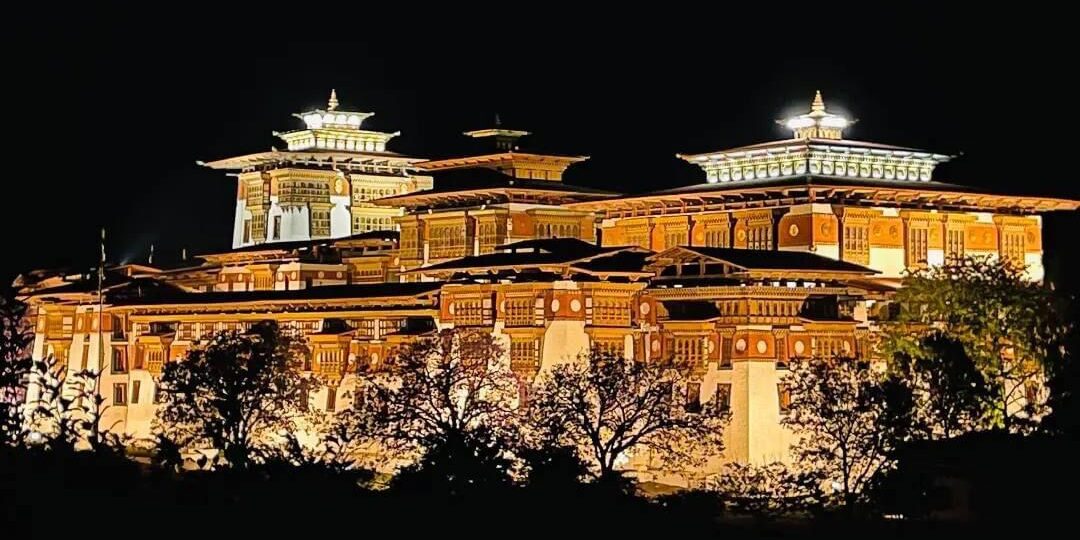
Tashichhodzong (Thimphu Dzong) – The “fortress of the glorious religion” was initially constructed in 1641 and restored by the Third King Jigme Dorji Wangchuck in the 1960s. Tashichhodzong houses some ministries,His Majesty’s secretariat, and the central monk body. (5 – 6 pm Mon – Fri, 8 am – 6 pm Sat & Sun, to 5 pm in winter).
Centenary Farmers’ Market – Every Saturday and Sunday most of the Thimphu population congregate onthe banks of the river where the weekend market is held. Here villagers from the valley and other nearby places come to sell their wide range of agriculture products. A visit to the market provides great photo opportunities, as well as the chance to mingle with local people and perhaps buy souvenirs.
Takin Enclosure – On the way to the viewpoint over Thimphu is the home of Bhutan’s national animal, theTakin, a strange looking beast some say looks like a beestung moose.
Sangaygang (BBS Tower) – Drive about 15 minutes from the main city to a hillock where the Bhutan Broad Casting Tower is stationed. From there you can relish the beautiful scene of the whole of Thimphu City. On the way up or down from the hillock, you can also see Takin the national animal of Bhutan. It is also possible to request for early morning walk up to this view point.
Handmade Paper factory– The paper factory in Thimphu produces traditional paper known as the Deh-sho. You can observe the complete ancient process of papermaking at the factory. Traditionally the papers were used by the monks to write prayer texts and manuscripts. Later the factory was set up in 1990 to preserve the tradition of paper making and also to commercialize it. Currently, the handmade paper is exported to US, Europe, Japan, India, and Nepal. The factory also has a small shop which sells the handmade papers along with other products such as books, greeting cards, paper bags and lamp shades, all made from the paper.
Around Thimphu Town – Shop and walk around Thimphu town.
Day 3: Thimphu to Punakha
Elevation 1,300m | Drive time 3 hours
We will set off early from Thimphu after breakfast, perhaps with a visit to the weekend market first. Then proceed to Punakha, the ancient capital of Bhutan, about 2 1/2 hours’ drive from Thimphu across Dochu-lapass. Once you cross the pass, you wind down into a warm fertile valley and meander along a gently flowing aquamarine river that leads you to the Punakha Dzong, the second dzong to be built in Bhutan.
Dochula Pass – at 3,050m, this beautiful pass with its 108 Bhutanese stupas was built by Her Majesty theQueen Mother Ashi Dorji Wangmo Wangchuck to commemorate victory over the Indian militants and to liberate the souls of the lives lost.
Chhimi Lhakhang – The divine madman also known, as Drukpa Kinley is a famous teacher with whom the phallic symbol is associated. Tales told by your guide would have excited you to visit Chhimi Lhakhang. TheDivine Madman sits there though a statue this time. Do not miss the master’s deeds painted on the walls. Japanese and several American couples visited this temple and were blessed miraculously with children. Ask yourself, do I need this Fertility Tour or not?
Punakha Dzong – Placed strategically at the junction of the Pho Chu and Mo Chu rivers, the dzong was built in 1637 by Zhabdrung Ngawang Namgyal to serve as the religious and administrative seat of the region. It was here that the dual system of government was introduced in the 17th century and in 1907, enthroned thefirst King Gongsar Ugyen Wangchuck. Damaged over the centuries by four catastrophic fires and an earthquake, the dzong has been fully restored in the recent years by the 4th King Jigme Singye Wangchuck.
At the dzong enrich your trip with the opportunity to see the highest standards in woodwork. Do not miss themassive Kuenray, the Coronation Hall of all Bhutanese kings, the Dzongchung at the entrance to the dzong and the cantilever bridge over the Mochu that has been recently renovated.
Pho Chhu Suspension – Bridge the 160 meters Pho Chhu Suspension Bridge is known for the longest suspension bridge in Bhutan, which gives you spectacular views of Punakha dzong and the Pho Chhu Valley.
Day 4: Punakha to Gangtey
Elevation 2,900m | Drive time 2.5 hours
The valley of Phobjikha is well known as the winter home of the Black necked crane (Grus Nigricollis). Bhutan is home to around six hundred black necked cranes with Phobjikha being one of the popular places that the birds migrate to in the winter months from the Tibetan plateau. The elegant and shy birds can be observed from early November to end of March.
Gangtey Goempa– Situated south of the road and east of Wangdue Phodrang, is Gangtey Gompa, an old monastery dating back to the 17th century. The largest Nyingma monastery in western Bhutan, it was founded in 1613 by Gyalse Pema Thinlay.
Nature Hike along the valley of Phobjikha– A short trek of about 90 minutes known as the ‘GangteNature Trail’ starts from the Mani stone wall to the north of the Gangteng Gonpa and ends in Khewa Lhakhang.
Black-Necked Crane Information Centre – The valley of Phobjikha is well known as the winter home ofthe Black necked crane (Grus Nigricollis). Bhutan is home to around six hundred black necked cranes with Phobjikha being one of the popular places that the birds migrate to in the winter months from the Tibetan plateau. The elegant and shy birds can be observed from early November to end of March.
Black-Necked Crane Information Centre, which has informative displays about the cranes and the valleyenvironment. You can use the center’s powerful spotting scopes and check what you see against its pamphlet ‘Field Guide to Crane Behavior’. If the weather’s iffy you can browse the library and handicraft shop, and watch videos at 10am and 3pm (Nu 200).
Day 5: Punakha to Paro
Elevation 2,280m
Paro Valley – The beautiful valley is home to many of Bhutan’s old monasteries and temples. The country’s only Airport is in Paro. The valley is also home to mount Chomolhari (7,300 meters) situated at the northernend of the valley whose glacier water forms the Pachu flowing through the valley. The following are some of the prominent places to visit in Paro.
Paro Dzong (aka Ringpung Dzong) – Explore the Rinpung Dzong which the locals call the ‘fortress of a heap of jewels’. Built in 1646 by Zhabdrung Ngawang Namgyal, the dzong stands on a hill above Paro Township. It is linked by the traditional cantilever bridge (called the Nemi Zam) over the Pa chu where one may pose aphotograph. Experience a walk up a paved stone path running alongside the imposing outer walls. Once insidethe Dzong, you will be welcomed by the monks, architecture and the ancient frescoes.
National Museum (Paro Ta Dzong) – On a ridge immediately above Rinpung Dzong is Ta Dzong, originally built as a watchtower. In 1968, Ta Dzong was inaugurated as the first National Museum, and now holds afascinating collection of art, relics, religious thangkha paintings, Bhutan’s exquisite postage stamps, coins and handicrafts, together with a small natural History collection. Start or end your trip with a visit to this marvelous museum.
Day 6: Paro (Tiger Nest Excursion)
Elevation 2,280m
Clinging precariously to a granite cliff 800 meters above the Paro Valley is Taktsang Monastery “Tiger’sNest”. The breath-taking scenery is definitely worth the challenging climb up to the viewpoint.
Taktsang Monastery (Tiger’s Nest) [6 hrs] – Often called the Tiger’s Nest, perched on the cliffs, has awestruck many a visitor. “Trip to Bhutan is never complete without climbing to Taktsang”, says one tourist.Indeed it’s true as the journey there fills you with spiritual bliss. For those not choosing the spiritual side it is the dramatic, artistically built
monument that becomes a hiker’s delight. Take a trip to this dramatically set Buddhist relic hanging from a cliff. Experience the uphill climb as you ascend more than two thousand feet from the valley floor.
A prominent Himalayan Buddhist sacred site and temple complex locatedon the cliff side of Paro Valley. According to legends, it is believed that Guru Rinpochhe flew to this location from Tibet on the back of aTigress (his consort Yeshey Tshogyal) and meditated in one of the caves. Guru Rinpochhe performed meditation and emerged in eight manifestations and the place became holy. Thus gaining the name Tiger’s Nest.
Kyichu Lhakhang – Also known as Kyerchu Temple or Lho Kyerchu, is the oldest temple in Bhutan. Just like Jambhay Lhakhang in Bumthang, it is one of the 108 temples built by the Tibetan King Songtsen Gampo to subdue and pin down an ogress that was obstructing the spread of Buddhism.
According to legend, all 108 temples were built in a single night. Go back in time and history and visit the 7thcentury Kyichhu temple. As the name suggests, the temple is a reservoir of peace, where you will really feel at peace here.
Day 7: Departure
Today we will bid fond farewell to this beautiful Himalayan country. We hope by now you would have made some friends and also kept many photos and beautiful memories of Bhutan! And we look forward to seeing you again inthis beautiful land of endless Enchantments! Tashi Delek!